The Memo
Part Five: Vitriol at the Boston Symphony


On Friday, March 6, the Boston Symphony Orchestra fired Music Director Andris Nelsons. You are reading a series of articles inspired by the controversy.
Part One, Murder at Symphony Hall, is about the “murder.”
Part Two, Drowning in Red Ink, is about the BSO’s recurring fiscal challenges.
Part Three, LA LA Land, covers the BSO’s failed attempt to import a new business model.
Part Four, Hostetter’s Do-Over, introduces Chad Smith, the BSO’s third CEO in three years.
Part Five is about deception, deflection, and blaming.
The outrage over Andris Nelsons’ firing would not die. With bad press mounting and fundraising stalled, Board Chair Barbara Hostetter wrote a memo summarizing the state of the BSO. Someone leaked a copy to Malcolm Gay, a reporter at The Boston Globe, who wrote a detailed story about it.
(Did she write the memo herself, or did someone else write it? The exact authorship doesn’t matter; it’s under her signature, so she owns it. For this post, I assume that the Globe story accurately reflects its contents.)
Hostetter wanted everyone to ignore the elephant in the room. Without explaining why the BSO needed a new music director, she explained the process to find a new one. A committee of eleven would do the search, including five orchestra members.
That’s great. Five musicians and six Hostetter puppets.
According to Hostetter, the BSO wants a Music Director with the following qualities:
Compelling artistic vision
Superlative musicality and podium skills
Outstanding rapport with our players
No other principal commitments
Willing and eager to work collaboratively and constructively with all of our key constituencies
In other words, Hostetter wants a unicorn. Anyone who meets the first two criteria isn’t likely to be available for the 2027-2028 season. The only way to test rapport is through guest conducting; unless the BSO limits the search to those who have already appeared with the orchestra, the field is quite narrow.
With all respect to Herbert Blomstedt, he’s a bit too old for the role.
I can understand the BSO’s desire for an exclusive commitment. Good luck finding one. Andris Nelsons had no other long-term commitments when the BSO signed him in 2013; his CBSO role ended in 2014, and his Leipzig role began in 2017. One wonders why the BSO didn’t demand exclusivity before he filled his dance card.
That last point about working with key constituencies is a word salad. Dust off the fireman’s helmet.
Hostetter launched an extended defense of “affinity programming” designed to appeal to demographic groups “who have not traditionally felt welcomed in our performance venues.”
Does she mean Irish Catholics?
The Board sets broad strategic goals for the orchestra. It should not direct artistic programming; that is the Music Director’s responsibility. A Board that dictates programs undermines the Music Director’s credibility with musicians, critics, and the audience.
Some advice for Hostetter: stay out of the way and let the Music Director cook.
Ethnic targeting is a questionable strategy in Boston. The Los Angeles Philharmonic, Hostetter’s lodestar, has one program in next year’s subscription series that is clearly targeted towards the Hispanic community:
Ravel expert Gustavo Gimeno taps into his Hispanic heritage and love for the French composer during a special night of romance, Spanish and Mexican rhythms, and more.
One program, in a media market twice the size of Boston, where 50% of the population has a Hispanic heritage. Boston does not have ethnic communities anywhere near as large as those in Los Angeles. “Affinity programming” will not fill Symphony Hall.
Greatness and universal appeal are core principles of the BSO. Beethoven is the most widely performed symphonic composer because he wrote great music, not because symphony audiences are German-American. The canon has always had a broad reach; music does not require ethnic matching to find an audience.
Hostetter wanted the Board of Advisors to believe the BSO faces a fiscal crisis. Her memo used expressions such as “Business as usual is not enough,” and “We can no longer kick the can down the road.” While she identified some systemic and ongoing concerns, she did not identify any pressing and immediate issues.
Declining concert attendance. Hostetter claimed a 20-year decline in paid attendance at classical concerts. Paid attendance certainly matters; however, concert revenue is the most important fiscal measure.
As shown in Part I of this series, concert revenue increased under Nelsons. After the COVID shutdown, it hit a record high in fiscal 2024:
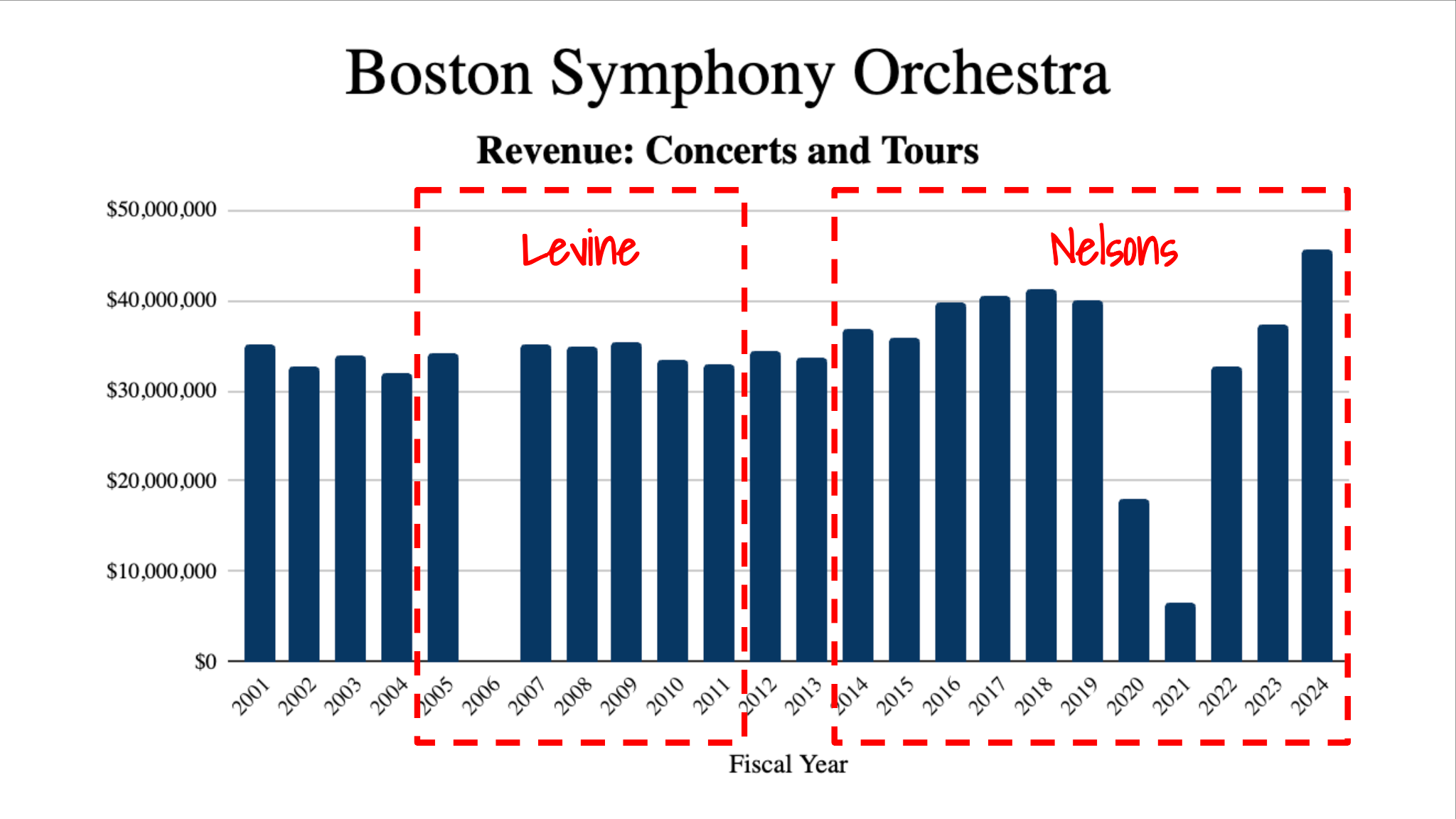
Source: Boston Symphony Orchestra Form 990s, FY 2001-FY 2024. (Data missing for FY 2006.)
The structural problem for the BSO is that expenses increased faster than revenue. Hostetter does not address this. She paints a misleading fiscal picture by focusing on attendance.
Recurring operating deficits. The BSO, like every American symphony orchestra, runs operating deficits every year. Henry Higginson understood this in 1881: he expected ticket sales to cover no more than 50% of costs and planned to cover the rest himself.
Operating deficits are not in a “long downward spiral.” They are endemic in the performing arts. If Hostetter still does not understand this fiscal reality after ten years on the Board, she should resign.
Excess endowment withdrawals. The BSO spent more money from the endowment than it earned. However, it’s misleading to say that operating deficits forced the overspending.
From fiscal 2009 through 2024, the BSO endowment earned $399 million but spent $419 million, according to IRS Form 990s. That is an excess withdrawal of $20 million. That’s concerning. The Board has a fiduciary duty to preserve the endowment principal.
The chart below shows BSO endowment expenditures for each fiscal year since 2009. Endowment spending was stable except for the years from 2016 through 2020. The BSO booked a surplus in 2018, the year of the largest withdrawal. The BSO raided the endowment to build the Linde Center, not to cover deficits.
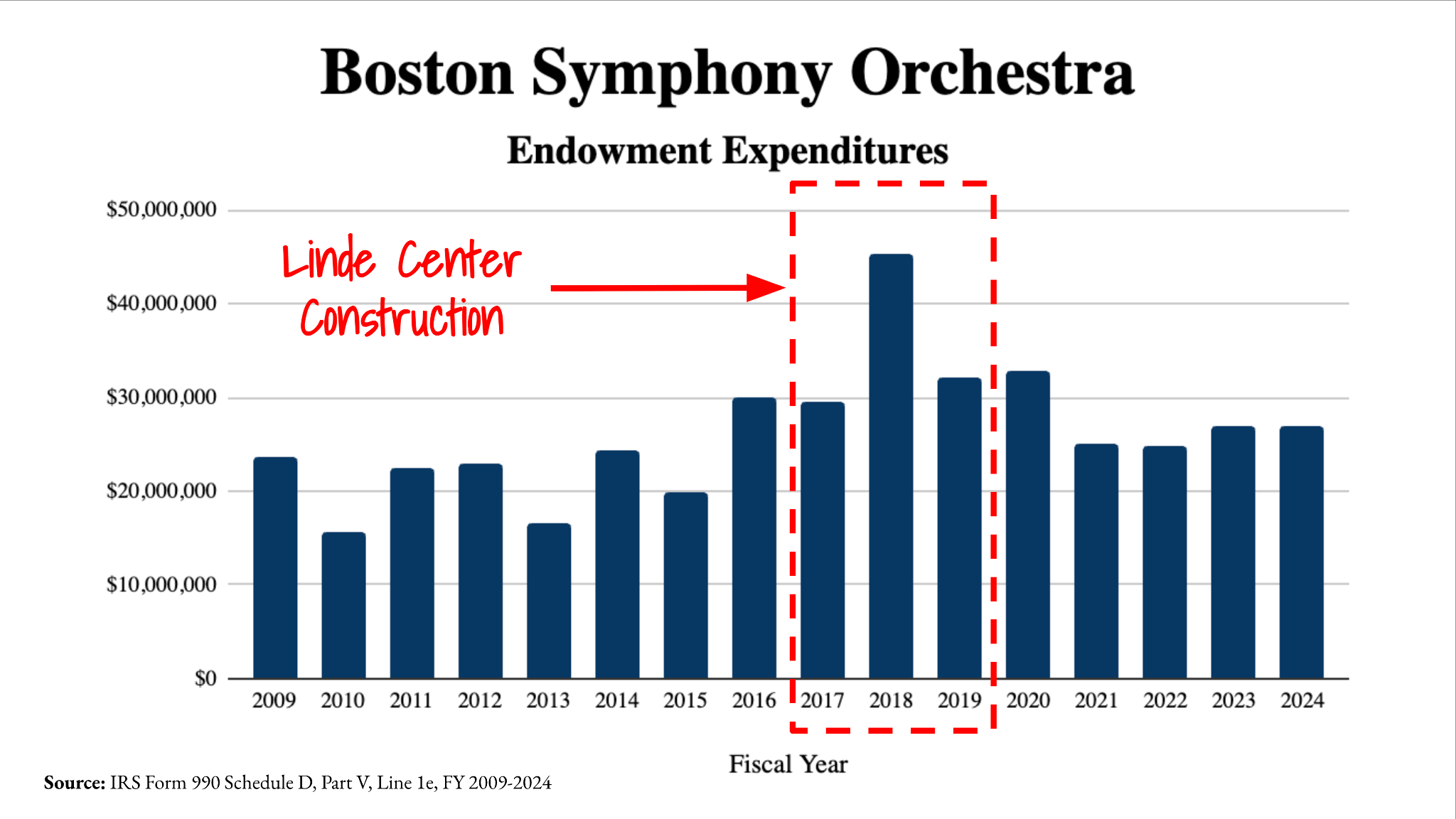
In fiscal 2024, the BSO endowment earned $59 million. The Board approved expenditures of $27 million. That’s a net surplus of $32 million. It’s grossly misleading to suggest that there is a crisis now.
Deferred maintenance. Symphony Hall is the BSO’s primary concert venue. If there are critical maintenance needs, that’s a major concern. It’s doubly concerning if the Board knew about those needs but chose to kick the can down the road.
Hostetter’s memo says the BSO faces some $100 million in deferred maintenance costs at Symphony Hall and Tanglewood, according to the Globe story. Chad Smith told another outlet that the estimate amounted to $90 million.
Ten million here, ten million there, what’s the difference?
Smith is also on the record about what he really wants. He wants to invest in digital infrastructure, multi-media capabilities, and build a co-working space in Symphony Hall. Also, he wants to refurbish Tanglewood’s Theatre Concert-Hall for opera productions and “transform Seranak.” Those projects may be worthwhile, but they are not “maintenance.”
Labeling renovations as “maintenance” is misleading and a poor strategy. Donors may be willing to support projects that modernize Symphony Hall and provide new capabilities for the future. They will be less willing to pay for fixing things that should have been fixed years ago.
An organization in crisis must focus ruthlessly on its core mission. All other activities are ancillary; either they directly support the core mission, or they generate profit that subsidizes the core mission. Mission creep is deadly for any organization, doubly so for a public charity like the BSO.
What is the BSO’s core mission? It is the concert performance of symphonic music of the highest quality for the largest possible audience. The music can be classical or contemporary, highbrow or popular, composed by anyone, living or dead, but enabling the music must be the main focus of the Board. Everything else is a distraction.
What is Hostetter’s plan? According to the Globe, her memo proposes a massive fundraising campaign to finance renovations, build the endowment, and fund a “cornerstone” educational program.
Raising money for genuine deferred maintenance may be necessary. Building the endowment is reasonable. But tying both to a major new “cornerstone” educational initiative is not. Education is not the core mission of the Boston Symphony Orchestra. The BSO’s existing education programs generate scant revenue. Launching an expensive new one during a claimed fiscal crisis is classic mission creep.
A “cornerstone” educational program is a vanity project. Kill it with fire.
Hostetter’s memo claimed that fundraising hit a new record last year. If that’s true, it’s great news; the previous record, set in 2009, was $52 million. With a haul like that, the BSO assuredly booked a surplus and did not need to make excess withdrawals from the endowment.
Unfortunately, according to the memo, fundraising stalled “in recent weeks.” The reason? “Bad actors” spread false and misleading rumors and innuendos. An earlier draft, accidentally released and subsequently retracted, went even further:
The determination of some within the BSO to resist suggestions for changes to business-as-usual is unfortunately nothing new. Many of those who are now attempting to undermine and discredit Chad Smith and the Board of Trustees employed the same tactics in 2021 and 2022 against the last new CEO the BSO engaged. The pattern they follow is, unfortunately, very clear: they will use any means at their disposal in their drive to thwart efforts aimed at reversing the BSO’s long downward spiral of declining audiences and persistent budget deficits and at making the BSO a more welcoming and inclusive place. They are heedless of the damage they cause to careers, reputations, and the BSO’s standing in our communities with constituencies other than our shrinking core audience. Given the long decline of the business model and the complexities of the current situation, we must ask ourselves whether the conditions for success for any CEO have been in place for the last quarter-century.
That’s nuts. Donors are upset that the BSO fired Andris Nelsons and bungled the transition. If Hostetter wrote that draft, I’m seriously concerned about her mental health.
Philanthropy is the lifeblood of the BSO. Over the past 25 years, charitable contributions have accounted for more than a third of its total revenue. Donors expect stability and competent leadership. They do not enjoy funding a clown show.
Barbara Hostetter behaves like a bull in a china shop — recklessly churning the front office and discarding a capable, popular Music Director without a proper transition. The damage to the BSO’s reputation and donor confidence will linger for years.
Now she flails, blaming “bad actors” for the consequences of her own decisions. Until the BSO’s leadership demonstrates basic competence and respect for its core artistic mission, serious donors would be wise to sit on their checkbooks.
Growing up in New Jersey, I tuned in to the BSO broadcasts. The orchestra was a beacon of excellence and stability; it was one reason why I migrated to Boston for college more than fifty years ago, and never left.
In Part Six, I will outline what to watch for in the months and years ahead.
[[Tom - feel free to delete this if you wish! But here's what Claude has to say about mission creep]]
Mission creep in a nonprofit occurs when the organization gradually takes on activities, programs, or goals that fall outside its original purpose — often without a deliberate strategic decision to expand. It typically happens through well-intentioned responses to funding opportunities, community needs, or board pressure.
How it causes harm:
-- Diluted impact. Resources spread across unrelated programs mean the core mission gets less attention. A food bank that starts running job training, housing assistance, and legal aid may do all of them adequately and none of them well.
-- Funding distortion. Grants often drive mission creep. When a funder offers money for a program adjacent to the mission, nonprofits are tempted to stretch their stated purpose to qualify. Over time, the organization ends up shaped by funders' priorities rather than its own.
-- Organizational confusion. Staff, volunteers, and donors become unclear about what the organization actually stands for. Recruiting, communications, and fundraising all become harder when the mission is fuzzy.
-- Overhead strain. Each new program area typically requires new expertise, compliance requirements, reporting obligations, and administrative infrastructure. This raises costs without proportional benefit to the original mission.
-- Board and leadership distraction. Governance energy shifts toward managing complexity rather than advancing strategic goals.
-- Reputational risk. If a tangential program fails or generates controversy, it can damage the credibility the organization built in its core area.
Why it's hard to resist:
-- Saying no to funding feels irresponsible when budgets are tight
-- Board members often champion new programs as signs of growth
-- Community needs are real and urgent, making refusal feel callous
-- Success in one area creates pressure to replicate it elsewhere
How nonprofits guard against it:
A strong mission statement with clear boundaries, a disciplined program evaluation process, and a board willing to decline funding that doesn't align are the main defenses. Some organizations do a periodic "mission audit" — reviewing every program against the founding purpose and asking whether it would be started today if it didn't already exist.
The paradox is that mission creep often looks like success from the outside (growth, new programs, more funding) while quietly undermining the organization's effectiveness and identity.
[[Just sayin'. Thanks again for this series.]]
Love this: “The orchestra was a beacon of excellence and stability; it was one reason why I migrated to Boston for college more than fifty years ago, and never left.” The BSO is a jewel in our Boston culture. If this incompetent Board damages the BSO, as they have already by firing Maestro Nelsons and insulting the musicians, they damage the city and the audience who treasures its culture. How can ruthlessly promoting a secret agenda, bullying, and endless misrepresentations possibly qualify this ignorant Board for stewardship of a great orchestra?