Hostetter's Do-Over
Part Four of Symphony Blues

On Friday, March 6, the Boston Symphony Orchestra fired Music Director Andris Nelsons. You are reading a series of articles inspired by the controversy.
Part One, Murder at Symphony Hall, is about the “murder.”
Part Two, Drowning in Red Ink, is about money.
Part Three, LA LA Land, is about envy.
Part Four is about Barbara Hostetter’s second choice.
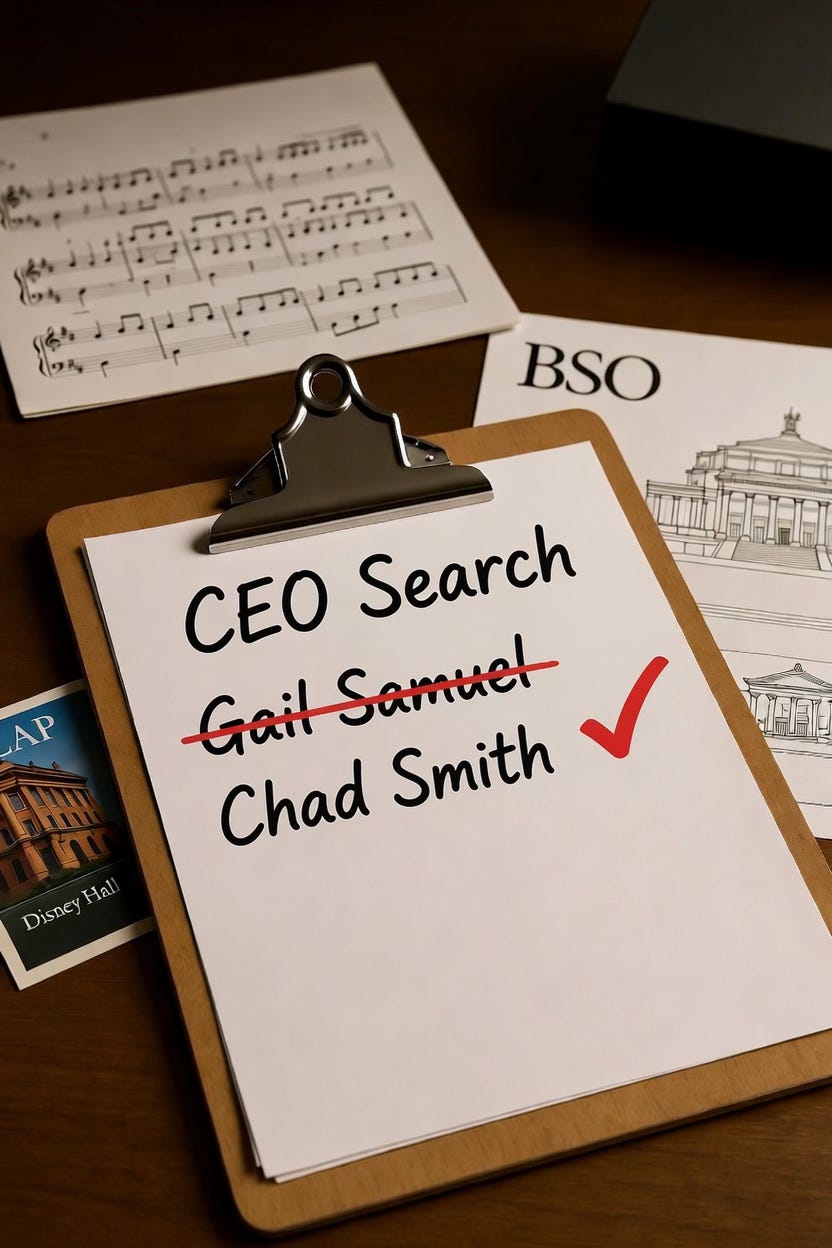
Gail Samuel resigned in December 2022, after less than two years on the job. Barbara Hostetter, still pulling strings as BSO Board Chair, installed an interim CEO, donned her search hat again, and returned to Los Angeles. There, she hired another Los Angeles Philharmonic lifer: Chad Smith.
Smith earned a little more than a million dollars at the LAP. Hostetter offered him roughly the same to lead the Boston Symphony front office. People who are good at their jobs are hard to pry loose. If Smith was truly the “top orchestra manager of his generation,” as the Los Angeles Times wrote, one wonders why the LAP let him go.
Smith joined the BSO in September 2023. Meanwhile, Hostetter had already hired a new CFO and a new Director of Tanglewood. By doing so, she undermined Smith’s authority before he started.
The BSO launched a PR blitz for Smith. The Boston Globe interviewed him, helpfully noting that he likes Madonna and brushes his teeth. The story quoted him: “I want us to be intentional about where we’re going, instead of being pushed forward by where we’ve been”, which made him sound like a college sophomore. The Globe also published glowing praise from community leaders, without mentioning that several had just signed business agreements with the BSO.
The Globe story claimed that BSO revenue was down. That was false; as the Form 990s show, concert revenue was up sharply from the previous year. As it turns out, the 2023-2024 season was the BSO’s best ever at the box office.
In an interview with WCRB, Smith gushed about Andris Nelsons:
I was just in Vienna last week, and (Nelsons) was conducting the Vienna Philharmonic. He was conducting Sibelius’ Second Symphony, and it was blisteringly good. The audience wouldn’t let him leave. I was backstage with some of the players from the Vienna Philharmonic, and they said, ‘you’ve got quite a chief conductor’. And I said, ‘yes, we do.’
Smith shared his artistic opinions with the Berkshire Eagle:
During a recent conversation with The Eagle on the Tanglewood campus, Smith made it clear that, in collaboration with Music Director Andris Nelsons, he’s intent on reimagining the standard repertoire.
Thank you, Chad. Now go run the front office and leave artistic decisions to the Music Director.
Hostetter may have learned something from Samuel’s crash and burn. Instead of giving Smith the green light to start breaking things, she told him to start a strategic planning project.
Any coherent strategy begins with an understanding of the current state. We don’t know what challenges the BSO considered, but they surely included those detailed in Part Two of this series:
Growing gap between box office revenue and expenses
Lagging charitable contributions
Insufficient endowment income to cover the gap
Enumerating challenges is not enough; you need to understand root causes. The BSO seems focused on a belief that something is fundamentally wrong with the product: the dogs don’t like the dog food. Attendance is way down, they say.
The BSO’s own numbers don’t support that claim. In its annual reports to the IRS, the BSO claimed an increase in attendance until the COVID lockdowns. Since then, concert revenue has steadily increased; as noted above, fiscal 2024 was the orchestra’s best year ever for revenue from concerts and tours. The specific problem facing the BSO is that expenses have grown faster than revenue.
This is not a new problem that suddenly emerged in 2024. The BSO has always had this problem, and so has every other symphony orchestra. It is an inherent problem for the performing arts, as Princeton economist William Baumol pointed out in 1966.
What plan emerged from the BSO’s strategy process? Almost two years later, the BSO hasn’t shared a plan with the public, so we must rely on snippets and breadcrumbs in media reports. From what we know, the plan includes:
A revised mission statement
Refreshed artistic programming
A “cornerstone” educational program
Major investment in BSO facilities
Smith says he wants the BSO to perform more contemporary music. (Throughout its history, the BSO has performed music written by living composers.) He also wants to introduce “affinity programming” to target demographic groups “not welcomed by the BSO in the past.” (Nobody knows what this means.)
Educational programs include further investment in the Tanglewood Learning Institute. Smith also envisions lecture and film series, collaborations with other artists and art forms, post-concert discussions, and speakouts from the stage by artists. (Michael Tilson Thomas tried speakouts from the stage; that ended in tears.)
According to public reports, the BSO needs $100 million to address “deferred maintenance.” Smith also says he wants to build a co-working space and multi-media capabilities at Symphony, renovate Tanglewood’s Theatre Concert Hall, “transform” Seranak, and invest in digital infrastructure for all BSO properties.
There are three striking things about the BSO plan. The first is its triviality and lack of vision; it is a shopping list of “wants” that do little or nothing to address the BSO’s core fiscal challenges.
The second striking thing is its lack of donor appeal. Donors like vision. They want to build things. Any potential donor will ask why the BSO spent millions on the Linde Center, a luxury wedding venue, and let the main concert hall deteriorate.
What is the third striking thing? Nothing in this plan could have caused a breach with Andris Nelsons. Aside from vague calls to “refresh the programming,” the plan seems to focus attention on education and facilities, areas that aren’t generally part of the Music Director’s portfolio.
Hostetter’s three-year term as Chair expired in March, 2024. The Board had an opportunity to reflect on the BSO’s recent leadership blunders:
Failure to retain COO Kim Noltemy
Lack of a succession plan for Mark Volpe
The selection of Gail Samuel as CEO, a bad hire by any measure
Failure to monitor Samuel’s performance in her early tenure
Failure to position the BSO in the global digital concert hall
Absence of a clear vision, other than a desire to break things
The Board did not reflect. It rewarded Hostetter with another three-year term as Chair.
Posting on behalf of Brian Bell:
Even though BSO founder Henry Lee Higginson had, even adjusted for inflation, a fraction of the Hostetter's net worth, he took care of all the bills for the BSO, the salaries, the 6 annual tours, and building Symphony Hall. And once he had found a music director, he left all the musical issues to the conductor. With Higginson, there was no endowment, no development department, and very little that would pass for marketing. What little in additional donations came from the annual auction in the fall of a select number of seats to keep scalping to a minimum. For nearly a quarter of a century, the Boston Symphony was, by common consensus, the greatest orchestra in the world. It remains an awesome legacy.
Yet here we see what sort of legacy Barbara Hostetter has chosen for herself. For shame.
I tell you this has more politics and drama than some software companies we're aware of 🤦♂️