Why I Write About The BSO
It's not for money.

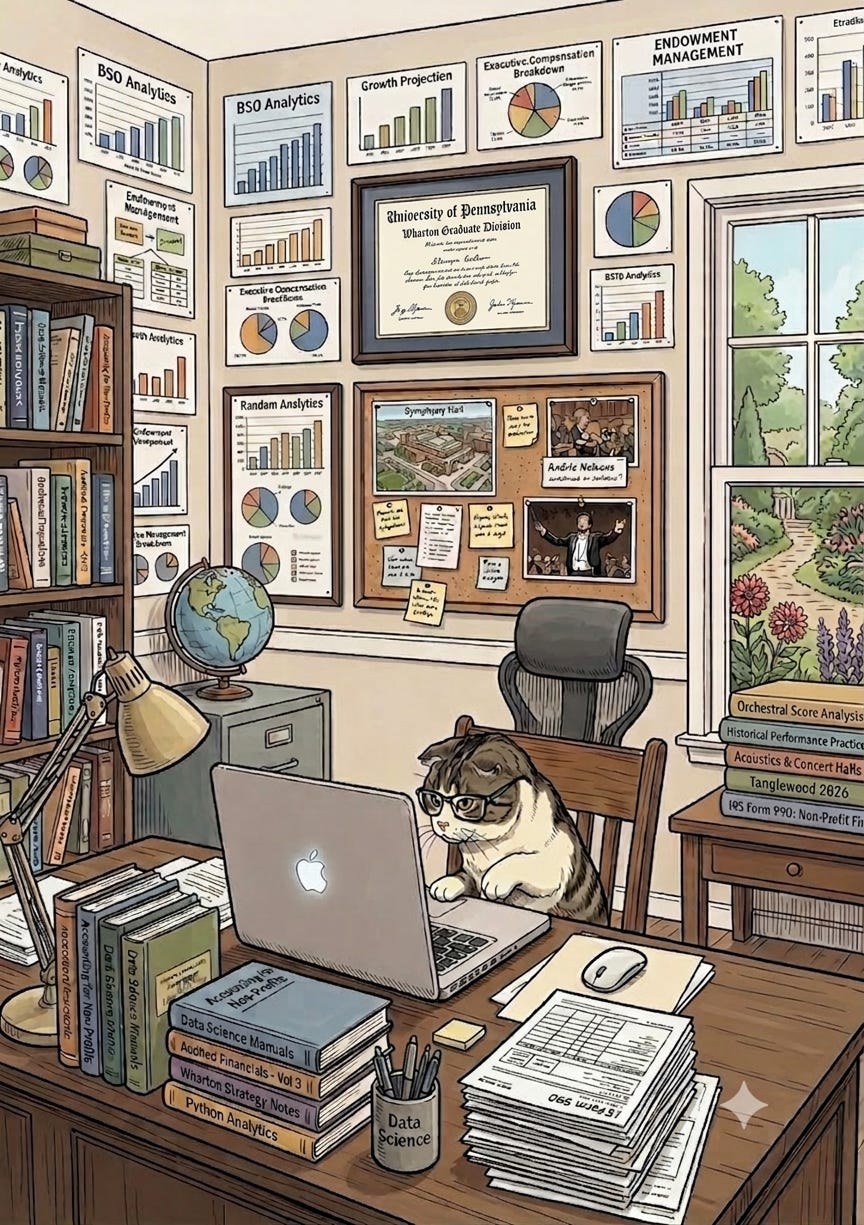
Longtime readers may wonder who hijacked my Substack. Most of my previous posts are about analytics, data science, and the software business, so I should explain why my recent stories are about the Boston Symphony Orchestra.
I’m not a paid agitator. Someone told members of the BSO Board of Trustees that the Red Flower Campaign is an astroturfed effort funded by dark forces. You don’t need to be a genius to figure out who’s spreading that calumny and why.
For the record, I have no personal or business connection with Andris Nelsons. In fact, I’ve never met him. I have no financial connection to any member of the Boston Symphony Orchestra or to the Boston Musicians’ Union, or to any former BSO Executive Director, or to anyone who has a financial interest in the current crisis.
I do not monetize my Substack. I neither solicit nor accept fees of any kind from anyone, for any reason. I have independent means and publish for the sheer joy of doing so.
So much for why I don’t write about the BSO. Now, a few words on why I do.
It’s all because of Pablo Casals.
In 1961, JFK invited Pablo Casals to perform at the White House. I saw this on a news clip and immediately wanted to play the cello. Mom checked with Mr. Totzauer at the Ridgewood School of Music, who said I was too small to play the cello, but I could start on the violin.
When I was eight, I played in my first symphony concert, at the tail end of the second violins. The program included Beethoven’s Fifth, a work I have subsequently performed numerous times. It never gets old.
At fourteen, I switched to the viola. Over the next few years, I made the rounds of city, regional, state, and national youth orchestras, culminating in a summer at Tanglewood in the Young Artists orchestra. In college, I continued to study the viola with Walter Trampler, but decided against a career as a professional musician.
Although I chose a different path, I never lost a sense of solidarity with professional musicians everywhere. Careers in music are exceptionally difficult, and those who make it to the highest level deserve enormous respect.
After completing undergraduate work, I secured an MBA at Wharton. Majoring in Accounting, I specialized in analytics for nonprofits and government. Wharton training stresses business ethics and the duty of stewardship: leaders of successful organizations balance the interests of all stakeholders, not just themselves.
I went to work for a strategy consultant, then worked as an analyst. In my forty-year career, I worked steadily through mergers, reorganizations, restructurings, layoffs, acquisitions, and IPOs. Through that constant change and flux, most of the business leaders I served practiced good stewardship, even under challenging circumstances.
A few did not. I’ve written previously about DataRobot executives lining their pockets, MD Anderson’s ethically failed AI project, and Olive AI’s Potemkin village.
After attending Wharton, I returned to Boston and have lived here ever since. From the sidelines, the BSO seemed like a stable and well-managed organization. A few years ago, though, the front office started to unravel. Friends whispered that the new CEO was in over her head. She resigned within the year, and so did the Director of Tanglewood, amid charges of a “toxic” workplace.
Despite living in metro Boston for 52 years, I have never received a solicitation from the BSO. We have attended concerts at Symphony, Tanglewood, Marlboro, Rockport, and Newport. We get invitations from the Handel & Haydn Society, the Celebrity Series, Cape Cod Chamber, Blue Hill, and the Monteux Festival. We give to local charities.
The BSO thinks we are not worth a stamp. When CEO Chad Smith asserts that the symphony audience is in a doom spiral despite the BSO’s best efforts, forgive me if I call bullshit.
Amidst the chaos, Music Director Andris Nelsons was an anchor. His calm musicianship served the orchestra well, and he took the BSO in new directions. Nelsons has a vision of music that connects people across borders and continents, a vision he made real through partnership with the Leipzig Gewandhaus Orchestra.
The BSO has no interest in artistic vision, so they fired him.
Nobody questions that the BSO has a right to fire the Music Director. He’s not an employee; he’s an independent contractor, so technically they just declined to renew his contract.
However, even if BSO leaders believed, in good faith, that the orchestra needed a new Music Director, they had a duty to work through that issue with Nelsons and the musicians. Not a legal duty or a fiduciary duty, but an ethical duty: the duty of stewardship.
Instead, they dismissed him without a succession plan. They failed to anticipate the uproar from musicians, patrons, and the public; it took the BSO more than two weeks to mount a feeble response. CEO Chad Smith’s subsequent public comments have been defensive, incoherent, and ill-informed.
The BSO Board of Trustees lives in a bubble of self-deception. They believe that because they are wealthy, credentialed, and connected, their decisions must be wise, prudent, and ethical, even when they clearly are not.
My interest is simple: I care about the future of the Boston Symphony Orchestra. The Board of Trustees breached its duty of stewardship. This story has legs.
Thank you for writing about BSO. It is a story worth following for all of us who have spent a lifetime in the arts and care deeply about them. Every nonprofit arts organization walks a fine line between artistic excellence and sound business practices—a balance that must be embraced by everyone, but especially by the board, whose responsibility is to steward both.
Thank you for taking action as a concerned patron of the arts! Your article debunking Chad Smith’s arguments about BSO’s dire financial situation was informative and interesting. Although I live in Olympia, Washington, I have enjoyed hearing the incredible BSO musicians play at Symphony Hall, the Shell, and at Tanglewood when visiting Boston. I’m hoping the Board of Trustees find their way back to true stewardship and listen to the people who love and support the BSO!