
The Brain Dump
In his first year as CEO of the Boston Symphony Orchestra, Chad Smith toured the media. He spoke of many things: his love for Andris Nelsons; his desire to make the BSO more inclusive; his plan to make Symphony Hall into a “cultural hub”, with an improved lobby, multimedia capabilities, and co-working space. At Tanglewood, he wanted to renovate Seranak and restore “Peter Grimes Hall”, his moniker for what everyone else calls the Theater-Concert Hall. (Note 1)
Things he did not talk about: deficits, the endowment, or deferred maintenance at Symphony Hall.
In April 2024, Smith hired Parthenon, a strategy consultant. Consulting is a relationship business; Parthenon had no experience in performing arts, but it had connections: former BSO Board Chair Bill Achtmeyer founded and led the firm for 29 years.
Smith and Parthenon commenced work on a strategic plan. For an organization the size of the BSO, a strategic plan should take about six months. Parthenon assigned three consultants to the team; they were intelligent, polished, diplomatic, and completely ignorant of the symphony orchestra business.
The strategy team collected data over the summer of 2024. Parthenon conducted a few interviews with BSO employees and fielded an audience survey.
In September, Smith presented his plan to an all-staff meeting. The plan lacked a clear statement of purpose and a strong analytics foundation. Smith treated strategic “pillars” as vague categories and dumping grounds for his ideas.
Smith spoke of “challenges”. He claimed, accurately, that costs had grown faster than revenue. The BSO had an “operating deficit” leading to “reliance on the unrestricted endowment”. That was misleading; the BSO recorded a positive cash flow of $29 million and added $6.6 million to the unrestricted endowment in fiscal 2024. (Notes 2,3)
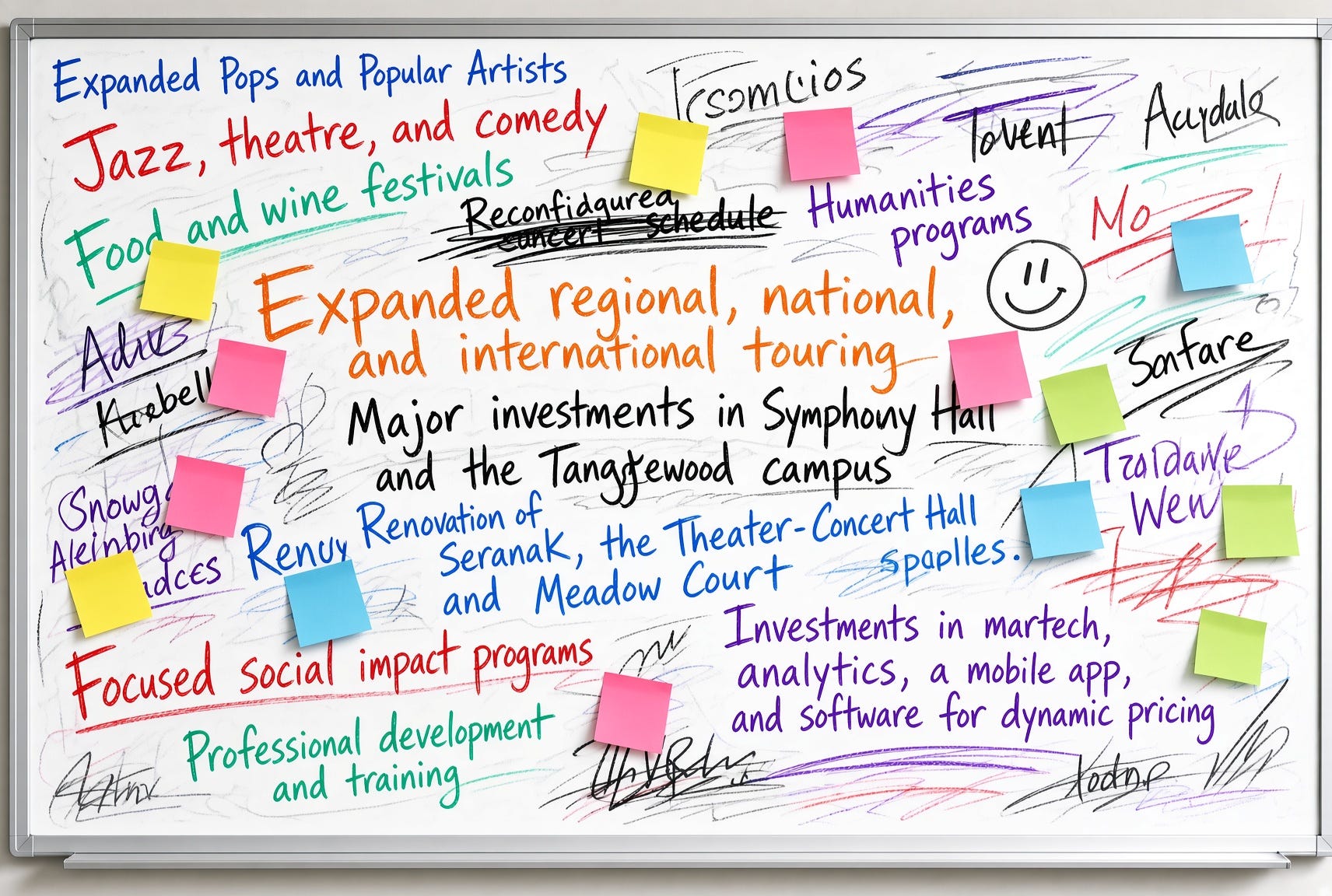
Smith read a sprawling list of “strategic opportunities.” These included:
Expanded Pops and Popular Artists
Jazz, theatre, and comedy
Food and wine festivals
Reconfigured concert schedule
Humanities programs
Expanded regional, national, and international touring
Major investments in Symphony Hall and the Tanglewood campus
Renovation of Seranak, the Theater-Concert Hall, and Meadow Court
Focused social impact programs
Professional development and training
Investments in martech, analytics, a mobile app, and software for dynamic pricing
So far, BSO musicians had provided minimal input to the plan. Andris Nelsons had provided no input at all.
It does not matter whether Smith’s ideas made sense. In a strategic planning process, when employees hear the CEO say “these are my ideas”, many will hear “this is what we’re going to do”. By floating his ideas this early in the process, Smith conveyed a message to BSO musicians and staff: your ideas don’t matter.
After the presentation, the strategy project went dark. Parthenon rolled off the project and disappeared. Smith did not present his plan to the Board; there was no chance they would approve his brain dump.
In fiscal 2024, the BSO expended more than $3 million on consulting fees. (Note 4)
The Do-Over
Smith spent the next ten months revising his strategic plan. In early August 2025, he shared a new draft. Smith had a new story to tell: the BSO had been in a long-term decline, but then, in a “pivotal moment,” the Board hired Chad Smith, and now things were looking up.
He refined his talking points. Concerns about diversity, inclusion, perceptions of value, recognition for innovation, and attracting talented people all disappeared; now, he focused on fiscal challenges.
The top problem on Smith’s list of concerns: “twenty years of persistent deficits”. It’s unclear what he meant: the BSO did not record “twenty years of persistent deficits”, according to public records. Presumably, Smith had some other definition of “deficit” in mind, but he did not spell it out. (Note 5)
For the record, the BSO recorded surpluses in most of the past 20 years. Like every other Big Seven symphony orchestra, the BSO also recorded some deficits. The Los Angeles Philharmonic recorded two deficits during Smith’s four-year tenure as CEO, including the largest deficit in its history. (Note 6)
The point requires a brief digression. No symphony orchestra covers expenses from concert revenue; the BSO has never done so. If Smith defined “deficit” as “failing to cover all expenses from concert revenue,” he understated the problem; the orchestra suffered from 145 years of persistent deficits.
Symphony orchestras depend on charitable contributions. That is why BSO founders organized the corporation as a public charity and not as a business. In any year, when fundraising meets or exceeds targets, the BSO records a surplus; when fundraising falls short, the BSO records a deficit.
Smith claimed that “deficits” (as he defined them) led to excessive spending from the endowment. He argued that deficits led to lost investment value, referring to the opportunity cost of spending rather than saving. It’s like saying that since you paid for your kids’ college, you put less money in the bank, where it could have earned interest.
He was wrong about endowment spending. Figure 1 below shows BSO endowment spending since 2009. The BSO spent modestly from the endowment in most years; the main exception was from 2016 through 2019, when the Board appropriated funds from the temporary endowment to build the Linde Center.
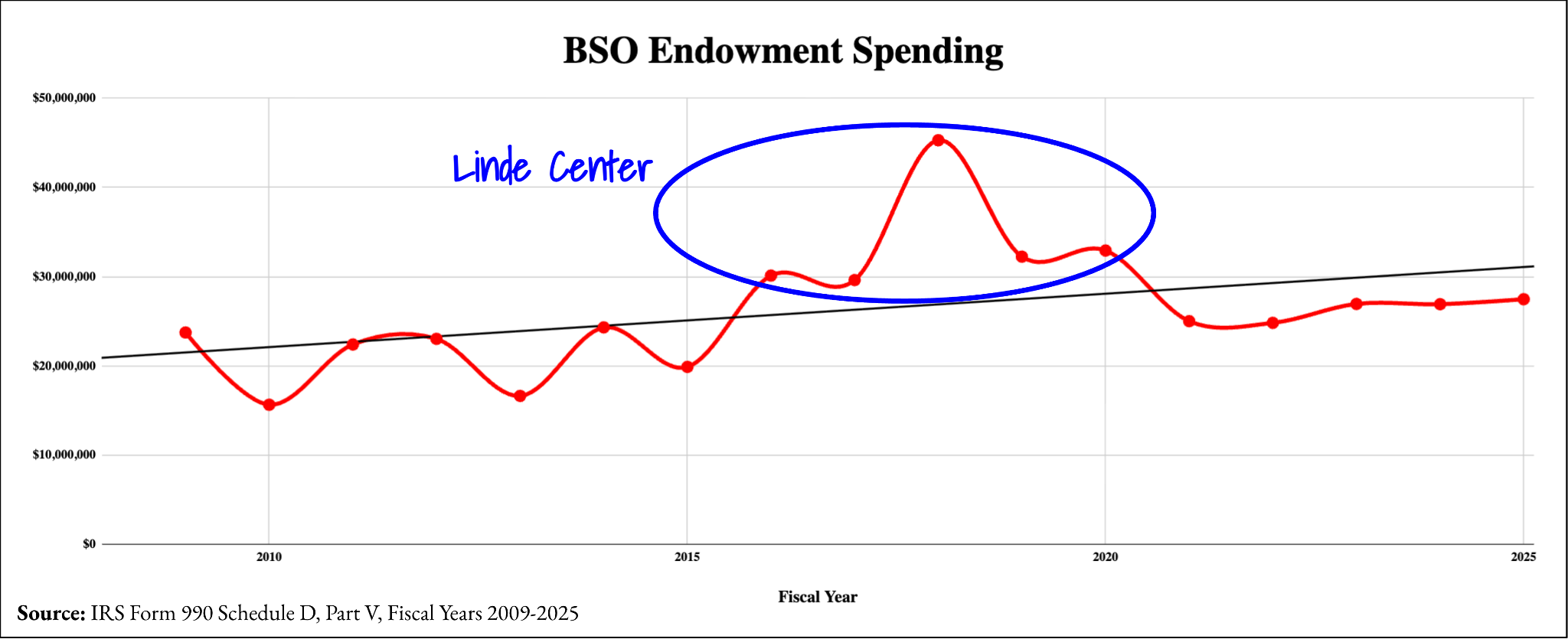
The BSO’s target payout rate is 5.25%. The average payout from the endowment for 2012 through 2024 was 5.16% when you control for the Linde Center spending. In brief, the BSO did not overspend the endowment. (Note 7)
Smith also claimed that BSO expenses exceeded revenue from 2016 through 2024. That claim was accurate but misleading. Why choose those nine years? Extending the window by one year in either direction would have flipped the result to a surplus.
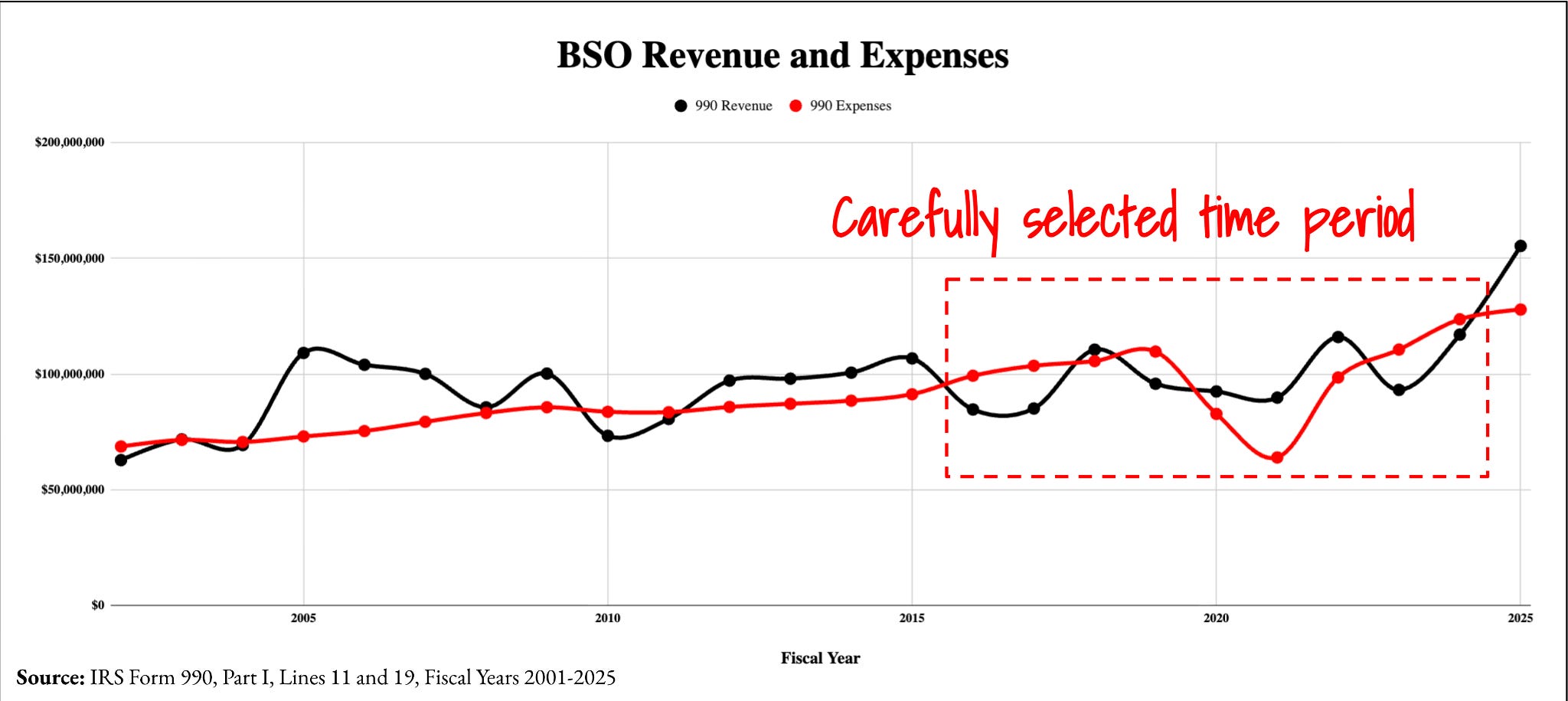
Revenue fell in 2016, 2017, and 2019 because fundraising fell short of targets. A competent strategic planning effort would ask why that happened. There are many possible explanations for that failure, but Smith wasn’t interested in understanding root causes.
Smith blamed Symphony programming. He pointed to reduced classical ticket sales, down 35% since 2005, and a decline in subscriptions from 28% to 11% of “major performance revenue”. Both claims were misleading; BSO filings show stable attendance through 2019, a sharp drop in 2020 owing to the truncated season, then slow recovery from the shutdown. Regardless of unit ticket and subscription sales, concert revenue steadily increased. (Notes 8,9)
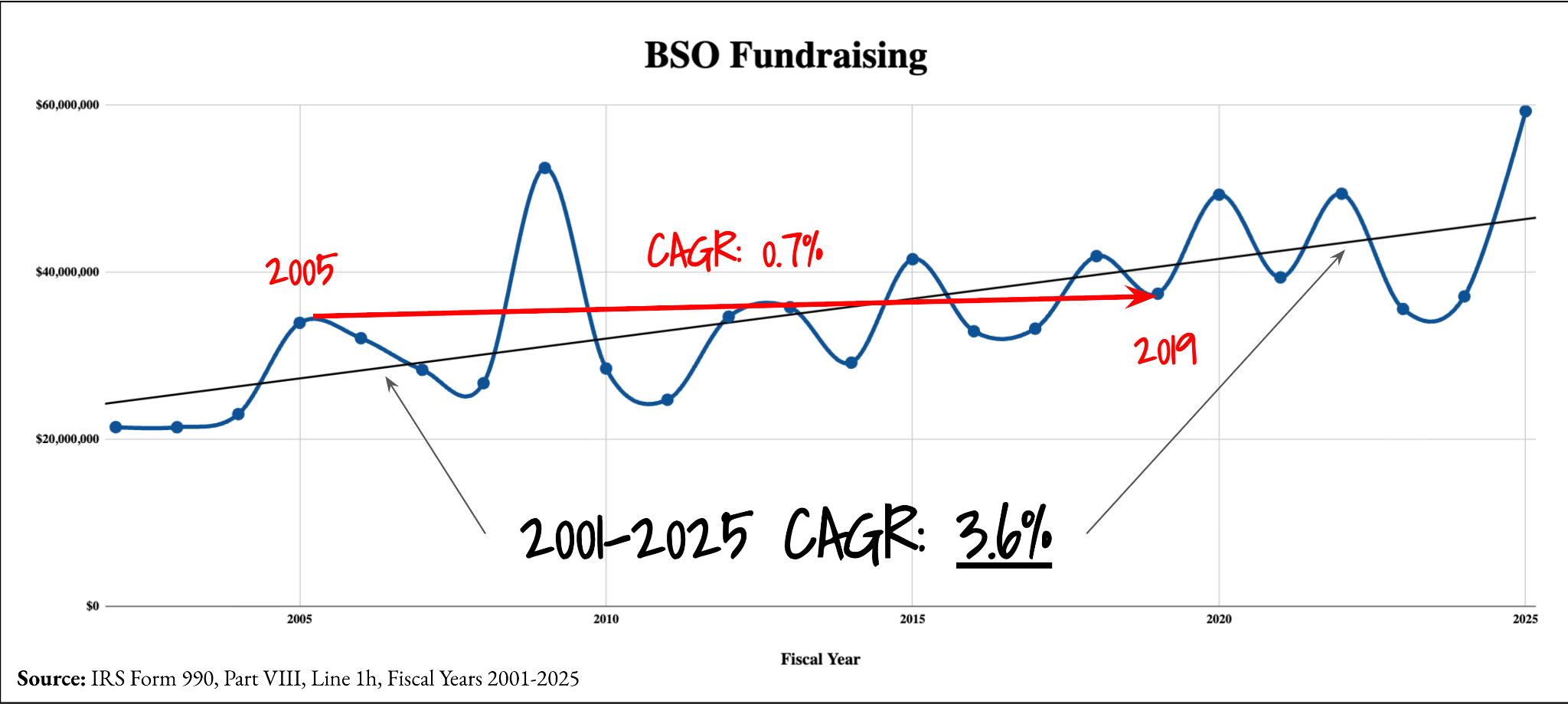
Smith claimed that BSO fundraising was “flat”. He supported this claim by calculating the compound annual growth rate (CAGR) in contributions from 2005 to 2019. Why those two years? Contributions surged in 2005 and fell short in 2019; as a result, Smith badly underestimated the true growth rate in contributions, as shown in Figure 3 below.
The first version of Smith’s strategic plan did not mention maintenance needs. In this version, he spotlighted “significant accumulated deferred maintenance” at Symphony Hall and Tanglewood. Whether that claim is true or not is unclear; the interesting question is why it was suddenly a priority.
Overall, Smith’s financial analysis lacked depth and curiosity. He noted industry issues known for years, and not unique to the BSO. To the musicians, it seemed he just wanted to prove that classical music was a dying business.
The “Vision”
Smith discarded most of the ideas from version one of his strategy. Instead, he proposed “artistic reimagination”, a “flagship” education program, and capital planning for Symphony Hall and the Tanglewood campus.
Smith detailed six “reimagined” programming initiatives:
Festivals
Symphonic cycles
Affinity programming
Artists-in-Residence
Institute for Orchestral Artistry
Artist-led curation
Festivals predate the BSO. In March 1856, Charles Callahan Perkins organized a Grand Beethoven Festival at the Music Hall in Boston. Gustav Mahler programmed a Historical Cycle with the New York Philharmonic over six concerts in 1910. Koussevitsky organized multiple BSO Beethoven festivals. Leonard Bernstein made festivals a staple during his tenure in New York; he organized a concerto festival, a Mahler festival, and Keys to the Twentieth Century.
Smith cited his E Pluribus Unum festival, claiming it a “success”. Most of the planned events for this festival had not yet taken place, so it seems premature to call it a winner. In most lines of business, we measure results before taking a victory lap.
For symphonic cycles, Smith listed Beethoven, Tchaikovsky and Stravinsky. He did not mention Nelsons’ award-winning Shostakovich cycle, the Strauss cycle, and the planned Mahler cycle. Smith highlighted strong business metrics for the recently completed Beethoven cycle.
Boston Pops affinity programming dates back to the Fiedler era. On July 29, 1934, Fiedler led the Pops in Irish Night at the Hatch Shell on the Esplanade. Longtime patrons remember Gospel Night, Celtic Night, Armenian Night, Old-Timer’s Night and Latin Night.
Smith cited Pride Night as an exemplar for affinity programming. Pride Night, launched in 2024, nearly sold out in 2025; that’s good news. Smith also named Day of the Dead as a win; ticket sales for that event declined 22% in 2025; that’s not good news.
Affinity programming works well for Pops, but not for symphony. The core appeal of classical music is its universality, not its niche appeal. Symphony orchestras do not program Beethoven because they want to appeal to German-Americans. Boston lacks a critical mass of Finnish-Americans; should the BSO stop programming Sibelius?
Some years ago, I performed in a work by Amy Beach. The audience included men.
Andris Nelsons launched the Artists-in-Residence program in 2017. The Institute for Orchestral Artistry is an umbrella brand for the Boston Symphony Chamber Players and Tanglewood Prelude Concerts, which Erich Leinsdorf introduced in 1964.
“Artist-led curation” enables outside artists to build BSO programs. Smith cited a Yo-Yo Ma recital as a win, which makes perfect sense; Yo-Yo is a great cellist, and he draws crowds. Smith listed other examples as “wins” but provided no business metrics.
Smith did not define his “flagship” education program. In 2025, education programs cost $4.4 million and contributed $488,000 in revenue; Smith presented no evidence that investing in education would address BSO fiscal concerns. (Note 10)
In the Fall of 2025, CEO Smith delivered two lectures about the plan to BSO players. Some musicians approached Smith with proposals and suggestions, with no success. There was some discussion about a new mission statement; Smith agreed to add the word “excellence”.
Finally, in December, Smith presented his new “strategic plan” to the BSO Board of Trustees. He asked the Board to approve a revised mission statement, to “affirm” strategic priorities, and more planning:
Symphony Hall Master Planning
Tanglewood Campus Planning
Education & External Engagement Strategic Planning
He also requested approval for a “Strategic Planning Task Force”. He misspelled “Planning”.
Smith’s plan had no substance. His plan for programming was a hash of things the BSO had done for years. He kicked plans for facilities and partnering down the road, and dropped the “people” initiatives entirely.
When Smith defined “early success,” he inverted BSO values. Beethoven succeeded because it made money, while Pops and events in other genres succeeded because they happened. To the musicians, his plan appeared to be fiscal responsibility for thee, but not for me.
This was the BSO “vision” in December 2025. Did Andris Nelsons embrace it? Was he clearly aligned on a collective path forward?
How do you embrace an empty vision?
Notes
Interviews with the Berkshire Eagle, the Boston Globe, WCRB, The Tufts Daily and others
Cash flow: BSO Consolidated Statement of Cash Flows, Fiscal Year 2024.
Unrestricted endowment: Note J, BSO Consolidated Financial Statements, Fiscal Year 2024.
Consulting fees: BSO Form 990 for Fiscal Year 2024, Part IX, Line 11g, and Schedule O, Note 8.
Contributions: BSO Form 990 for Fiscal Years 2016-2024, Part I, Line 8.
Surpluses and deficits: BSO Form 990 for Fiscal Years 2005-2024, Part I, Line 19; Schedule D, Parts XI and XII, Line 1.
LA Philharmonic surplus/deficit: Form 990 filings, Fiscal Years 2001-2024.
Payout: average payout rate of 5.16% is the average of the yearly payout rate for each year from 2012 through 2024, excluding 2016 through 2019. The annual payout rate is endowment spending divided by the trailing three-year average ending endowment balance, which simulates the operation of the BSO’s Yale Rule. BSO Form 990 filings, Fiscal Years 2012-2024, Schedule D, Part III.
Attendance: BSO Form 990 for Fiscal Years 2001-2025, Part III.
Concert revenue: BSO Form 990 for Fiscal Years 2001-2025, Part VIII, Line 2a.
Education: BSO Form 990 for Fiscal Year 2025, Part III, Line 4b.
I welcome criticism. Comment or DM me if you think I got something wrong.
The ability to fail upwards not once, but TWICE is absolutely frustrating. He may think he can fool the general public, but for those of us who actually worked there and know how the programs were run, it won't work. It is increasingly heartbreaking to see that the musicians and Andris Nelsons are carrying the weight of such incompetence. Thank you for your diligence and prime excavation skills, Thomas. The truth will get out soon- that is my hope.
Yet again, a scathingly effective analysis. A small point here regarding festivals: The BSO has had a contemporary music festival for decades. And for several years back in the 70s (and maybe 80s), under Tom Morris, the Tanglewood season began with a two-week Bach-Mozart festival. And lest we not see the forest for the trees, since 1938 the BSO has had the granddaddy of them all: the Tanglewood Music FESTIVAL.