
A Brief Recap
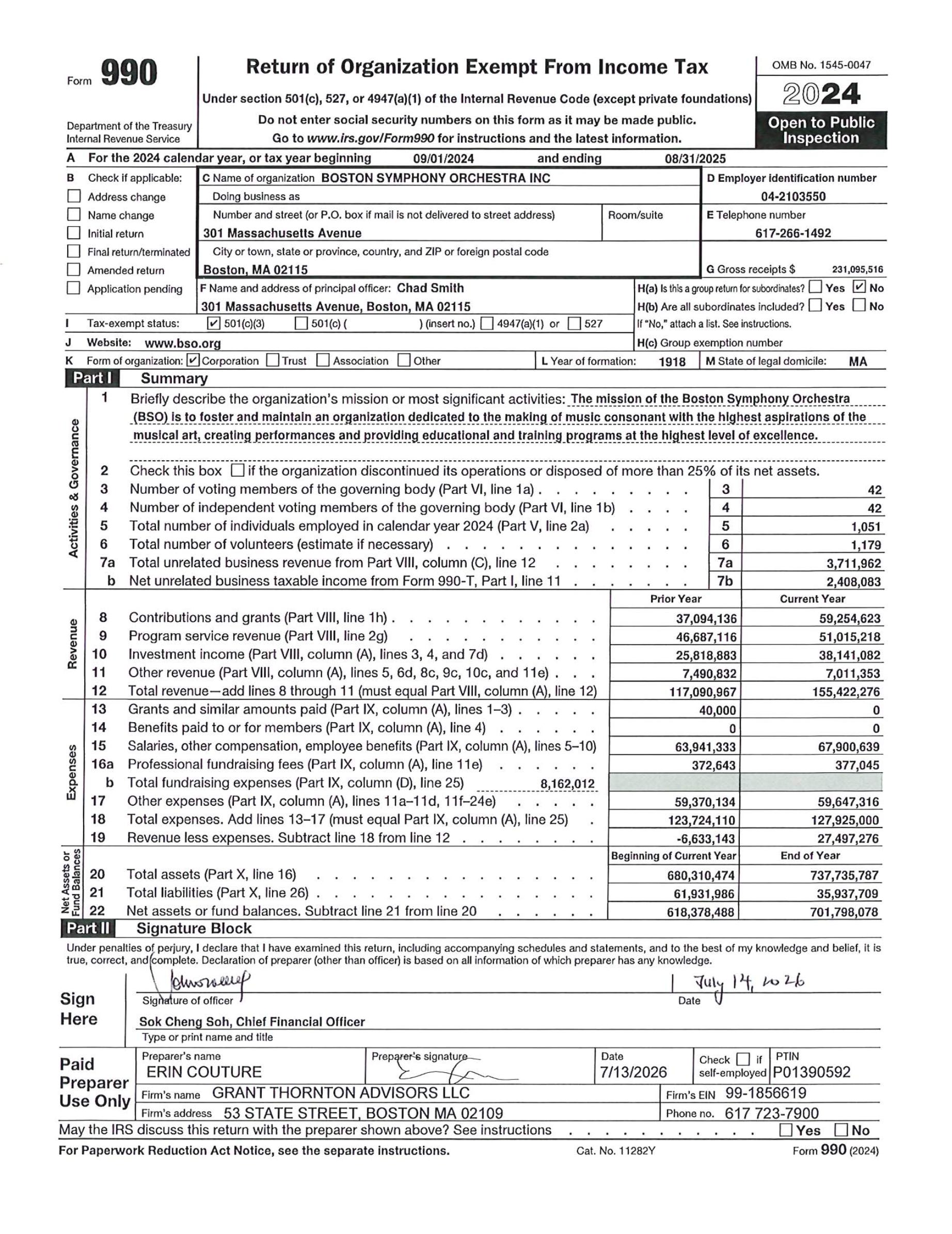
The Boston Symphony Orchestra filed its tax return for fiscal year 2025 on July 15. I published a short post that evening, with the topline news:
Record revenue of $155 million
Surplus of $27 million
Endowment valued at $603 million, $66 million unrestricted
In this post, I’ll provide a little more detail. Don’t worry: you won’t need an Accounting degree.
There’s a downloadable copy of the return at the bottom of this post. Post questions in the comments, or DM me.
Why This Matters
Why should we care about the BSO’s tax filing? If you do your own tax return, you know that the IRS has clear rules about reporting income. With minor changes, the rules are consistent and stable over time, so we can compare results from year to year; we can also compare results between symphony orchestras to see how well the BSO performs compared to its peers.
The BSO files its Form 990 under penalties of perjury. There are serious legal and financial consequences for any organization that doesn’t follow the IRS rules. Unscrupulous executives cannot manipulate the numbers on the return to support a particular narrative.
The most important takeaway: BSO leaders knew that fiscal 2025 was a record year before they sent Chad out to cry poverty.
Mining the Return
Part I of the return is a summary, and it’s self-explanatory.
Part III, the Statement of Program Service Accomplishments, starts on Page 2. It begins with the BSO’s new mission statement:
The mission of the Boston Symphony Orchestra (BSO) is to foster and maintain an organization dedicated to making music consonant with the highest aspirations of the musical art, creating performances and providing educational and training programs at the highest level of excellence.
The front office needed 18 months to produce that word salad.
Here’s the mission statement from the BSO’s 2001 990:
The principal mission of the Boston Symphony Orchestra is to perform music written for symphony and chamber orchestras and other music generally described as “classical music” at the highest level. Our mission also includes presenting this music to the greatest number of people.
The wordy narratives that follow describe things the BSO says it did last year. The person who wrote this devoted 481 words to Orchestral Music Programs that produce $84 million in revenue, and 988 words to Education programs that produced $488,120 in revenue. Banging the drum for foundation grants, I suspect.
The next four pages are BSO responses to IRS compliance questions. This may seem uninteresting until we get to line 28:
Was the organization a party to a business transaction with one of the following parties?
A current or former officer, director, trustee, key employee, creator or founder, or substantial contributor?
A family member of any individual described (above)?
The BSO responded “no” to both. We know that’s a wee bit of a fib, don’t we? Trustee Caroline “Kim” Taylor is the spouse of James Taylor, who most definitely engaged in a business transaction with the BSO. I mean, it’s right there in Part VII, Section B, Independent Contractors.
It seems that the BSO owes the IRS a Schedule L to disclose a related party transaction. I’m sure they just forgot about the transaction. But one wonders: how many other related party transactions did they forget?
Pages 7-10 list officers, trustees, and key employees. The definition of “key employee” is complex, and it includes some members of the orchestra. Schedule J (pages 39-41) shows more detail about compensation, if you want to see what the BSO pays Chad Smith. All of the comp figures are for calendar year 2024; the BSO awarded Chad a bonus for fiscal 2024 results, when the BSO recorded a deficit.
You won’t see Andris Nelsons listed among the employees. He’s an independent contractor, listed at the bottom of page 10. Other top independent contractors include a media strategist, a caterer, James Taylor (“Tisbury Tours”), and a security service.
The BSO hired mall cops the year before the Andris Nelsons snafu. They also paid media strategists $3 million in fiscal 2025. That’s a lot to pay for media strategy.
The Statement of Revenue is on page 11; page 12 shows the Statement of Functional Expenses. I’ll boil these down for you:
Fundraising, concert revenue, and capital gains drove revenue to a new high
The BSO kept a lid on expenses, which increased just 3%
There’s one interesting item in the Statement of Functional Expenses, but you must hunt for it. On line 11g, the BSO reports $19,982,868 in “Other fees for service.” Now skip to Schedule O, page 44, and read the eighth note from the top. Here, the BSO discloses in tiny type that it spent $2.5 million on consulting services in fiscal 2025. Add that to the $3.4 million the BSO spent for consultants in fiscal 2024, also disclosed in a footnote in tiny type, and you get $5.9 million. That is a lot to pay for a mission statement.
Page 13 is the balance sheet. Nothing obvious here, but skip to Schedule D, Part VI on page 27. Line 1b, column (b) tells you that the original cost of BSO buildings is $128,708,312. Now check the same schedule from fiscal 2024. Here, the original cost is $124,694,515. That tells you the BSO spent a little more than $4 million on building improvements in fiscal 2025.
I hope they fixed some of that deferred maintenance.
The balance sheet does not show the endowment. For that, skip to Schedule D, Part V, on page 27. The numbers here don’t line up exactly with the balance sheet because the BSO holds some assets outside of the endowment.
Schedules A and C (pages 15-25) are mostly blank. Same with Schedule F and G (pages 30-38), Schedule M (pages 42-43), and Schedule R (pages 49-53). There are a few entries here, if you are a glutton for detail.
Get Your Copy Here
The BSO’s 2025 Form 990 is 53 pages long. I’m not going to snapshot all that, but it’s a public record. Here are several ways to get a copy for yourself:
Contact the BSO and request a copy
Download a copy from the Massachusetts Attorney General’s Public Charities Filing Search
Download a copy from ProPublica’s Nonprofit Explorer
ProPublica takes forever to upload materials, and the AG website is clunky, so here is a copy you can download:

It took the Massachusetts Attorney General two weeks to upload the BSO filings. I filed a public records request.
The absence of any reference to the orchestral or symphonic art in the mission statement is glaring
Thanks for making these financials comprehensible. I appreciate the detailed explanations, but it’s the big picture that staggers me.
Chad Smith has made numerous false public statements regarding the BSO’s finances. Yet Barbara Hostetter, who pays him $1.3 million a year says nothing about his dissembling. Is she as inept at financial management as he appears to be?
When will the Trustees speak up and demand truthfulness?