Chad Speaks Again
Fact-Checking the BSO CEO

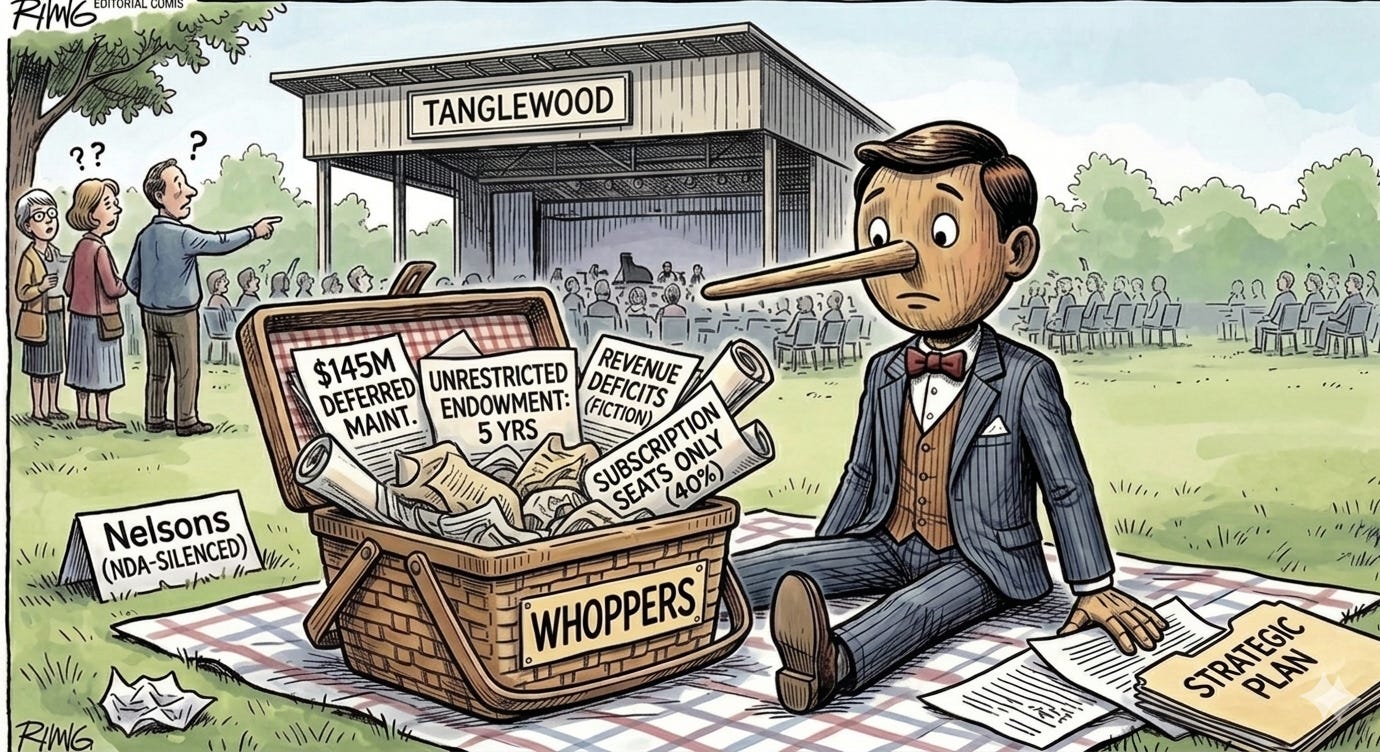
On June 18, the Berkshire Eagle published an extended interview with Chad Smith, CEO of the Boston Symphony Orchestra. Smith used the interview to justify firing Andris Nelsons, and he made numerous claims about the BSO’s financial condition. Let’s fact-check some of those claims.
Smith painted a dire portrait of the BSO’s finances, pointing out the need to spend at least $145 million over the next 10 years to cover deferred maintenance. Tanglewood’s share is 51 percent, just to maintain and upgrade current facilities, not including renovation of the Seranak mansion on Lenox Mountain Road overlooking the main campus, the shuttered Theatre-Concert Hall and the East Barn rehearsal space.
This claim is unsupported. Smith repeatedly changes the cost of “deferred maintenance”, but offers no engineering reports or construction estimates. Over the past fifteen years, BSO capital spending exceeded depreciation charges by $18 million; that demonstrates an actively maintained infrastructure, not a backlog of neglect. (Source: BSO Form 990 filings)
If the money will be spent over a period of ten years, it’s not deferred maintenance; it’s a capital investment plan. It’s reasonable for the BSO to propose improvements to its facilities; labeling the investments as “deferred maintenance” seems like tactical messaging.
The BSO completed its $70 million Tanglewood Forever campaign at the end of fiscal 2019. It seems odd that Tanglewood has a maintenance backlog after that recently completed investment.
Seiji Ozawa Hall, completed in 1994, rendered the Theatre-Concert Hall surplus.
Serge Koussevitzky donated Seranak to the BSO in 1951. Although the BSO has considered various uses for the property, the Town of Lenox has never agreed to change the residential zoning, rendering the property a white elephant.
(Smith) also described a 40 percent decline in seats sold at subscription orchestral concerts in Boston since 2004 — from 176,390 tickets to 101,435 in 2023-24. There were fewer classical orchestral programs at Symphony Hall, down from 87 in 2004-05 to 66 in 2023-24.
This claim is misleading and omits important context. Smith repeatedly uses this measure to paint a picture of long-term decline. He uses this narrative to support his call for radical changes to symphony programming.
The BSO reported the following attendance figures to the IRS:
2004-2005: 182,696
2018-2019: 213,790
2022-2023: 142,521
2023-2024: 159,787
(Source: BSO Form 990 filings)
The statistics do not show a sustained “20-year decline.” In fact, attendance increased under Andris Nelsons until the COVID lockdowns. Since the devastating COVID lockdowns, attendance has recovered slowly. Every American symphony orchestra reports the same slow recovery; the BSO is not unique.
Increased venue diversity explains reduced Symphony attendance.
In 2003-2004, all of the BSO’s 108 Winter season performances were in Symphony Hall or Carnegie Hall.
In 2023-2024, the BSO delivered 104 Winter season performances at Symphony Hall, Carnegie Hall, a tour of Europe, and a series of concerts in community centers around Boston.
(Source: BSO Performance History Search)
Smith’s count compares apples and oranges. He only includes attendance at Symphony Hall and omits winter season attendance at Carnegie Hall, the European tour, and the community concerts, which made up a larger share of the season in 2023-2024.
Also, Smith has not released attendance figures for the 2024-2025 and 2025-2026 seasons, likely because the updated figures do not support his narrative of decline.
“I came here knowing full well that the BSO had been in decline for a long time as a business,” Smith said. “It is an amazing orchestra — we have 100 of the finest musicians in the world. And yet the business that supports them has been so undercapitalized and so compromised over the past 20 years that there is a real concern on the board about viability going forward.”
This statement includes three claims about BSO fiscal affairs.
The BSO has been in decline for a long time as a business.
This claim is false. The BSO is not in decline by any business measure. In fiscal 2024, the orchestra booked revenue of $117 million, a record year. (Source: BSO Form 990 filings). The Los Angeles Philharmonic is the only American symphony orchestra with more concert revenue than the BSO.
The business that supports (the musicians) is undercapitalized.
This claim is false. The BSO has net assets of more than $600 million. This is more capital than any symphony orchestra in the world. (Source: BSO Form 990 filings)
There is a real concern on the board about viability.
This claim is speculative and unverified. It also seems unlikely. The BSO has earned a substantial surplus over the past twenty years; the unrestricted endowment currently stands at just under $60 million and has increased in the past two years. The BSO has ample liquidity, with $50 million in net current assets. (Source: BSO Form 990 filings)
Smith also cited 20 years of expenses exceeding revenue and too much dependence on withdrawals from the endowment. As he put it, “We had been spending down the unrestricted portion of our endowment in very significant ways. We now probably have about five years of unrestricted endowment left before we get to a real crisis.”
This statement includes four claims.
BSO expenses have exceeded revenue for 20 years.
This claim is demonstrably false. In the past 20 years, the BSO recorded a surplus in 13 years and a deficit in 7 years. Over this period, the orchestra recorded a cumulative surplus of $125,944,540. (Source: BSO Form 990 filings)
The BSO recorded a surplus of $29 million over the past five years. The Los Angeles Philharmonic, where Smith served as CEO, earned only $19 million. The LAP recorded two annual deficits under Smith’s leadership. (Source: BSO Form 990 filings; LAP Form 990 filings)
“Surplus” is a nice way to say “profit.”
This led to excess dependence on withdrawals from the endowment.
This claim is misleading. While it is true that the BSO made excess expenditures from the endowment, that was several years ago. The largest withdrawal was in fiscal 2018, during construction of the Linde Center.
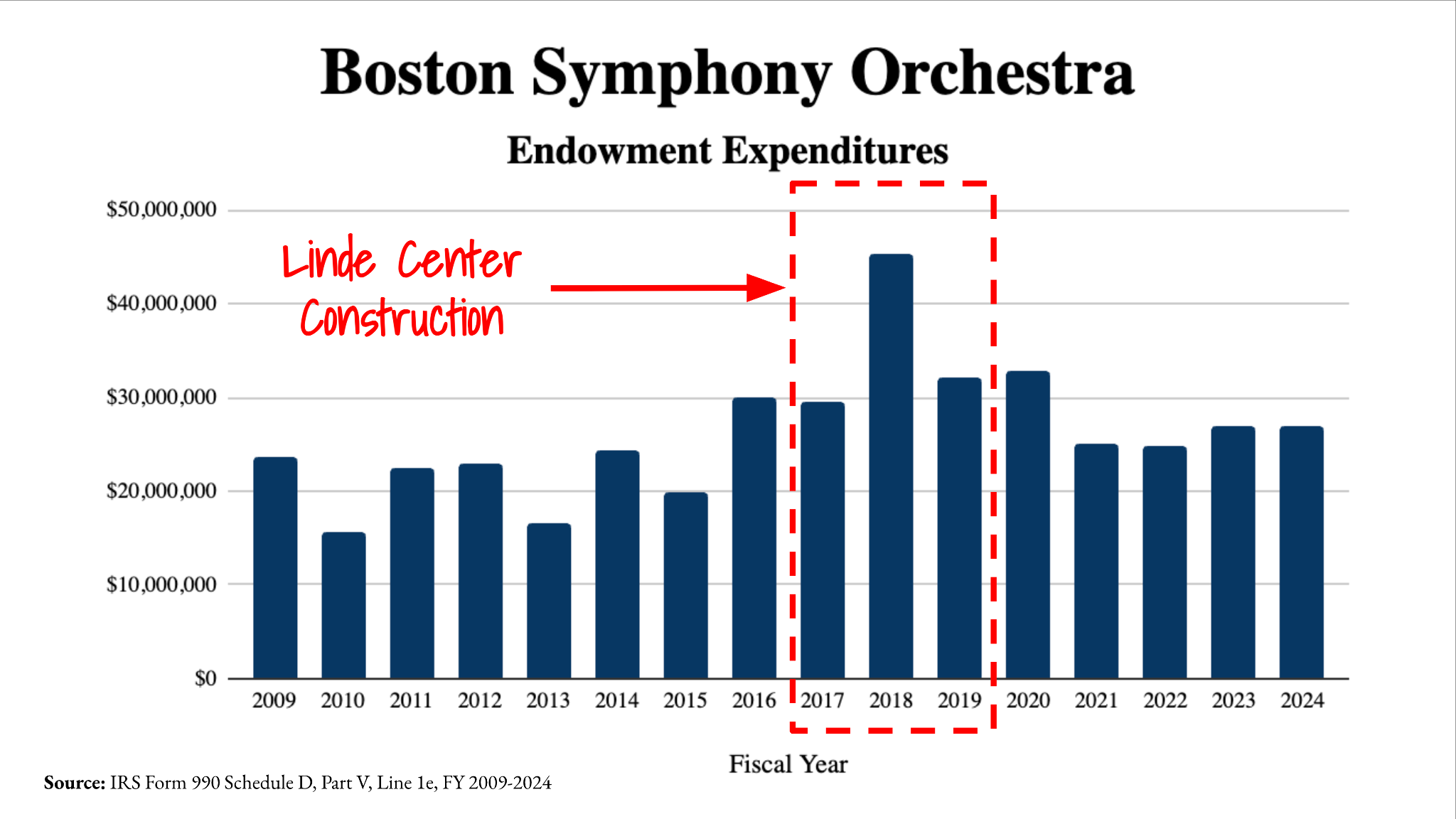
We have been spending down the unrestricted portion of our endowment in very significant ways.
This claim is false. At the end of fiscal 2001, the overall endowment balance was $576 million; of that, $63 million was unrestricted. In fiscal 2002 and subsequent years, the BSO took sustainable withdrawals of about $25 million per year.
The endowment portfolio suffered investment losses of $74 million in fiscal 2003. This reduced the overall value of the endowment to $484 million and the unrestricted balance to $48 million. Since then, the endowment as a whole increased to $536 million, and the unrestricted endowment to $59 million.
Investment losses, not overspending, reduced the value of the unrestricted endowment. (Source: BSO Form 990 filings)
We now probably have about five years of unrestricted endowment left before we get to a real crisis.
This claim is counterfactual. Since the unrestricted endowment balance increased in the past two fiscal years, there is no adverse trend.
As the trustees completed a strategic plan, “Andris said ‘I don’t support that future vision,’ ” Smith said.
“So when you are faced with that issue, what decision do you have to make? We have to focus on rebuilding the foundation of the BSO,” Smith said. “I have a very expansive view of what an orchestra can and should do.”
Smith’s claim about the dispute is unverified. Because Nelsons is bound by a non-disclosure agreement, the public is only permitted to hear management’s framing of this disagreement. Presenting a one-sided narrative as an absolute justification for a leadership rift, while the other party is legally barred from offering their perspective, undermines the credibility of the strategic plan itself.
A well-executed strategic planning process produces alignment among all stakeholders. If Nelsons wasn’t “aligned” with the proposed vision, the planning process failed. Planning for the future is difficult, and there is always conflict. Strong and competent leaders invite disagreement and work towards compromise.
Let’s recap the fact-check:
False Claims: Four times in a one-hour interview, Smith made claims about BSO business affairs that contradict the BSO’s IRS returns, filed under penalty of perjury.
Misleading Claims: Smith cherry-picks statistics and omits context to build narratives of a long-term decline in attendance and excess endowment spending.
Unverified Claims: Smith provides no evidence to support his assertions about “deferred maintenance,” BSO viability, and Nelsons’ rejection of the future vision.
Smith speaks recklessly. As CEO, he has a duty to know the facts about his organization and speak truthfully in public. His narrative of decline and imminent ruin damages the reputation, donor trust, and institutional stability of a leading American symphony orchestra.
This fact check also exposes a glaring failure in arts journalism. Many of Smith’s statements contradict data in easily accessible open-source databases. Some of his claims even contradict data on the BSO website. Arts journalists should not serve as passive stenographers for Chad Smith and the BSO Board.
As a former BSO musician, watching the wholly unnecessary internal strife has been distressing. One hopes that the pressure being exerted from many corners, not the least yours, will lead to the institutional change that so many of us want.
Thanks, Mr. Dinsmore. You deserve a Pulitzer for your investigative reporting, which, as you note, arts journalists from major publications have failed to do. You are a one-man Woodward and Bernstein. You have provided the documented information that the hitherto gutless BSO Trustees have chosen to ignore.